Noise

1

The noise floor

24 bits at 5 V full scale: \(\frac{5 V}{2^{24}} \approx\) 298 nV, the noise of 50 Ω in 96 kHz

\[SNR = 6.02 \cdot B + 1.76 \text{ dB} = 146 \text{ dB at } B = 24\]

The best DAC of 2005: 120 dB, about 19.6 bits

2

Three things that come in pieces

What is discrete Noise it gives
Charge, \(q\) Shot noise, \(2qI\)
Energy per mode, \(hf\) Thermal noise, \(4kTR\)
Localized states, traps Telegraph noise, then \(1/f\)
3

Statistics

\[\overline{x(t)} = \lim_{T\to\infty} \frac{1}{T}\int^{+T/2}_{-T/2}{ x(t) dt} \tag{1}\]

\[\overline{x^2(t)} =\lim_{T\to\infty} \frac{1}{T}\int^{+T/2}_{-T/2}{ x^2(t) dt} \tag{2}\]

\[\sigma^2 = \overline{x^2(t)} - \overline{x(t)}^2 \tag{3}\]

\[R_x(\tau) = \overline{x(t)x(t + \tau)}\]

4

Average Power

\[P_{av} = \lim_{T\to\infty} \frac{1}{T} \int^{+T/2}_{-T/2} x^2(t) dt \tag{4}\]

\[P_{av} = \frac{1}{N}\sum_{i=0}^N x^2(i) \tag{5}\]

5

Noise Spectrum

\[S_x(f) = 2\int_{-\infty}^{\infty}{R_x(\tau)e^{-j2\pi f \tau}d\tau} \tag{6}\]

\[\overline{x^2(t)} = \int_{0}^{\infty}{S_x(f)df} \tag{7}\]

\[S_y(f) = S_x(f)\vert H(f)\vert ^2 \tag{8}\]

\[f_x = \frac{\pi f_0}{2} = \frac{1}{4 R C}\]

6

Probability Distribution

**Theorem 1** (Central limit theorem). *The sum of \(n\) independent random variables subjected to the same distribution will always approach a normal distribution curve as \(n\) increases.*
7

PSD of a white noise source

\[R_x(\tau) = \overline{x^2(t)}\,\delta(\tau) \quad\Rightarrow\quad S_x(f) = 2\,\overline{x^2(t)}\]

White: the same power density at every frequency

8

Summing noise sources

\[v_{tot}^2(t) = (v_1(t) + v_2(t))^2 = v_1^2(t) + 2v_1(t)v_2(t) + v_2^2(t)\]

\[\begin{aligned} \overline{e_{tot}^2} &= \lim_{T\to\infty} \frac{1}{T}\int^{+T/2}_{-T/2}{ v_{tot}^2(t) dt} \\ &= \lim_{T\to\infty} \frac{1}{T}\int^{+T/2}_{-T/2}{ v_1^2(t) dt} \\ &+ \lim_{T\to\infty} \frac{1}{T}\int^{+T/2}_{-T/2}{ v_2^2(t) dt} \\ &+ \lim_{T\to\infty} \frac{1}{T}\int^{+T/2}_{-T/2}{ 2v_1(t)v_2(t) dt} \\ &= \overline{e_{1}^2} + \overline{e_{2}^2} + \lim_{T\to\infty} \frac{1}{T}\int^{+T/2}_{-T/2}{ 2v_1(t)v_2(t) dt} \end{aligned}\]

9

\[\overline{e_{tot}^2} = \overline{e_{1}^2} + \overline{e_{2}^2}\]

Uncorrelated sources: the cross term averages to zero, and the powers add

10

Signal to Noise Ratios

\[\begin{aligned} SNR &= 10 \log\left(\frac{Signal\:power}{Noise\:power}\right)\\ &= 10 \log\left(\frac{\overline{v_{sig}^2}}{\overline{e_{n}^2}}\right)\\ &= 20 \log\left(\frac{v_{rms}}{\sqrt{\overline{e_{n}^2}}}\right) \end{aligned}\]

11

Noise figure and Friis formula

\[F = \frac{\overline{v_o^2}}{source\:contribution\:to\:\overline{v_o^2}}\]

\[NF = 10 \log(F)\]

\[F = \frac{SNR_{input}}{SNR_{output}}\]

\[F = 1 + F_1 - 1 + \frac{F_2 -1}{G_{1}} + \frac{F_3-1}{G_{1}G_{2}} + ....\]

12

Spectral Density

  • Two definitions in the literature, a factor of two apart
  • Both: spectral density is the Fourier transform of the auto-correlation
13

Definition of Spectral Density

\[S_{x1}(f) = \int_{-\infty}^{\infty}{R_{x1}(\tau)e^{-j\omega\tau}d\tau}\]

\[S_{x2}(f) = 2\int_{-\infty}^{\infty}{R_{x2}(\tau)e^{-j\omega\tau}d\tau}\]

\[S_{x2}(f) = 2S_{x1}(f)\]

14

Sources of Confusion

\[\overline{x_2^2(t)} = \int_0^{\infty}{S_{x2}(f)df}\]

\[\overline{x_1^2(t)} = 2\int_0^{\infty}{S_{x1}(f)df}\]

\(S_{x1}\): two-sided, signal processing books. \(S_{x2}\): one-sided, noise books

15

Example: Thermal Noise

\[S_{th}(f) = 4kTR\]

\[S_{th}(f) = 2kTR\]

16

Einstein: The source

\[\mathfrak{M} (\Delta) = \overline{F(t)F(t + \Delta)}\]

\[I(\theta) = \int_0^{T}{\mathfrak{M}(\Delta) \cos ( \pi \frac{\Delta}{\theta})d\Delta}\]

17

Where white noise comes from

18

Thermal noise is Planck

\[S_V(f) = 4R\frac{hf}{e^{hf/kT}-1} \approx 4kTR \quad \text{if } hf \ll kT\]

\[\frac{kT}{h} = 6.25 \text{ THz at 300 K}\]

19

Shot noise is the electron charge

\[\overline{i_n^2} = 2qI\,\Delta f\]

In weak inversion, with \(\gamma = n/2\) and \(g_m = I_D/nV_T\)

\[4kT\gamma g_m = 4kT\frac{n}{2}\frac{I_D}{nV_T} = 2qI_D\]

20

Where flicker noise comes from

21

Schrödinger

\[i\hbar\frac{\partial}{\partial t}\Psi(\vec{r},t) = \left[-\frac{\hbar^2}{2m}\nabla^2 + V(\vec{r})\right]\Psi(\vec{r},t)\]

Stationary states, \(\Psi = \psi(\vec{r})e^{-iEt/\hbar}\)

\[-\frac{\hbar^2}{2m}\nabla^2\psi + V\psi = E\psi\]

22

Fermi-Dirac

\[f(E) = \frac{1}{1 + e^{(E - E_F)/kT}}\]

\[n = \int_{E_C}^{\infty} N(E) f(E)\, dE\]

23

One trap

24

What a trap is

  • A broken bond at the Si/SiO2 interface, or a defect a few nm into the oxide
  • A bound state: \(\psi_T\) localized to an atom or two
  • An energy \(E_T\) inside the silicon bandgap
25

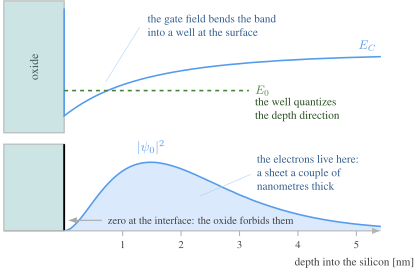
The channel electron has a tail

\[\psi_{ch}(x) \propto e^{-\kappa x} \text{ in the oxide}, \quad \kappa = \frac{\sqrt{2 m_{ox}(\Phi_B - E)}}{\hbar}\]

\[\Phi_B = 3.1 \text{ eV}, \quad m_{ox} \approx 0.5 m_0 \Rightarrow \kappa \approx 6.4 \text{ nm}^{-1}\]
26
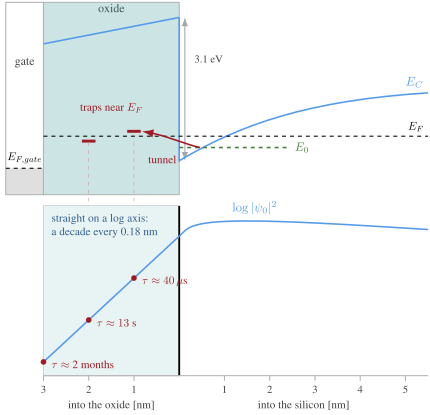
Tunnelling sets the time constant

27

Dirac's golden rule

\[\frac{1}{\tau} = \frac{2\pi}{\hbar}\left\vert\langle\psi_T\vert H'\vert\psi_{ch}\rangle\right\vert^2 \rho(E)\]

\[\left\vert\langle\psi_T\vert H'\vert\psi_{ch}\rangle\right\vert^2 \propto e^{-2\kappa x_T}\]

\[\tau = \tau_0 e^{x_T/\lambda}, \quad \lambda = \frac{1}{2\kappa} \approx 0.08 \text{ nm}\]

Trap depth \(\tau\) (\(\tau_0\) = 0.1 ns)
0 nm 0.1 ns
1 nm 40 µs
2 nm 13 s
3 nm 2 months
28

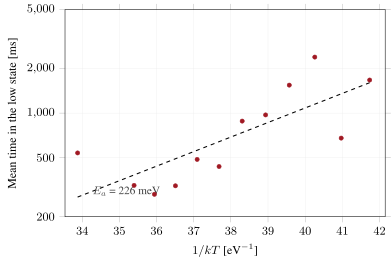
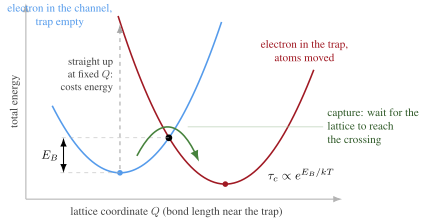
The lattice must move

29

Capture and emission

\[\frac{1}{\tau_c} \propto e^{-x_T/\lambda}\, e^{-E_B/kT}\, n_s\]

\[\frac{\tau_c}{\tau_e} = \frac{1}{g}e^{(E_T - E_F)/kT}, \quad g = 2\]

\[\frac{\partial \ln(\tau_c/\tau_e)}{\partial V_{GS}} = -\frac{q}{kT}\frac{x_T}{t_{ox}}\]

30

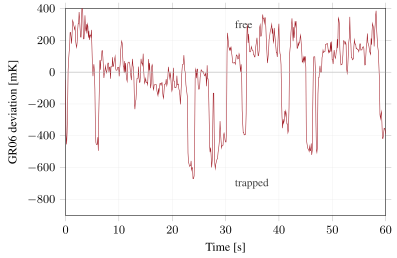
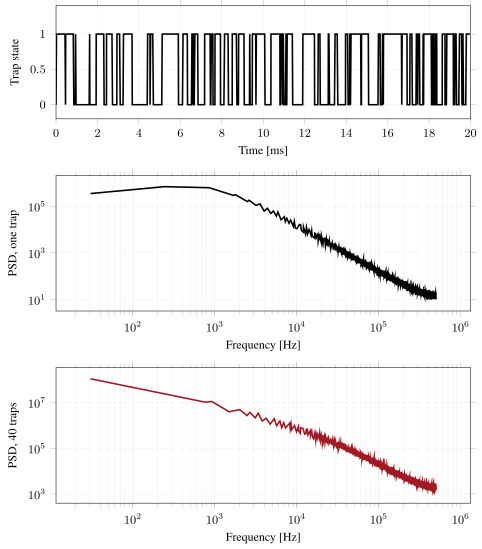
What one trap looks like

31
32
33

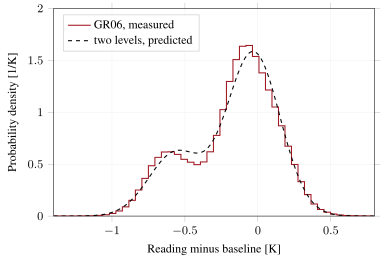
Not one Gaussian

34

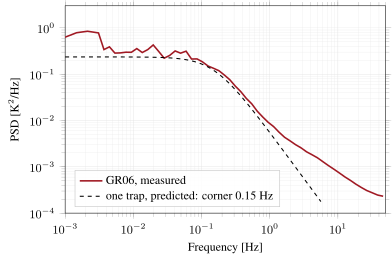
Two states, one Lorentzian

\[R_x(\tau) = \Delta I^2 \frac{\tau_c\tau_e}{(\tau_c + \tau_e)^2} e^{-\vert\tau\vert/\tau_0}, \quad \frac{1}{\tau_0} = \frac{1}{\tau_c} + \frac{1}{\tau_e}\]

\[S_x(f) = 4\int_0^\infty R_x(\tau)\cos(\omega\tau)d\tau = \frac{4\,\Delta I^2}{(\tau_c+\tau_e)\left[\left(\frac{1}{\tau_c}+\frac{1}{\tau_e}\right)^2 + (2\pi f)^2\right]}\]

35

The Lorentzian, measured

36

How big is one step?

\[\Delta V_T = \frac{q}{C_{ox}WL}\left(1 - \frac{x_T}{t_{ox}}\right), \quad \Delta I_D = g_m \Delta V_T\]

W x L \(\Delta V_T\) \(\Delta I_D/I_D\) at \(g_m/I_D\) = 20
0.42 µm x 0.15 µm 305 µV 0.6 %
1 µm x 1 µm 19 µV 0.04 %
10 µm x 10 µm 0.19 µV 0.0004 %

sky130 nfet_01v8: \(t_{oxe}\) = 4.148 nm, \(C_{ox}\) = 8.3 fF/µm²

37

How many traps?

Per decade of time constant

\[N \approx N_t \cdot kT \cdot W L \cdot \lambda \ln 10\]

\(N_t = 4 \times 10^{17}\) cm\(^{-3}\)eV\(^{-1}\) (sky130 nfet), \(kT\) = 26 meV, \(\lambda\) = 0.1 nm

W x L Active traps per decade
0.42 µm x 0.15 µm 0.15
1 µm x 1 µm 2.4
10 µm x 10 µm 240
38

Which transistor in GR06?

39

How GR06 works

  • A PTAT current, divided by 100 in two mirrors, charges a 53.8 fF MIM capacitor
  • A comparator trips when the ramp reaches \(V_{ref} = V_{DD}/3\), from three poly resistors
  • Pulse width \(t = C V_{ref}/I \approx\) 7.1 µs, so \(I \approx\) 4.5 nA
  • Every analog transistor is a 3.2/0.94 µm unit, deep in weak inversion; the reset switch is 1.92/0.22

\[\frac{\Delta t}{t} = \frac{\Delta V_{ref} + V_{os}}{V_{ref}} - \frac{\Delta I}{I} = 1760 \text{ ppm}\]

40

Is it the supply?

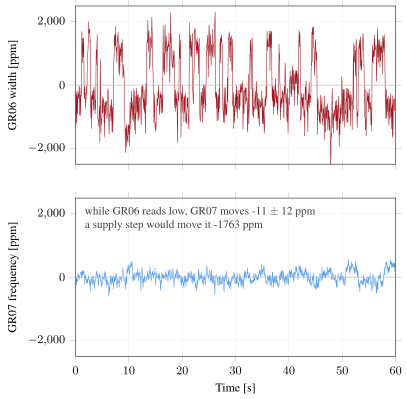
41

Memoryless

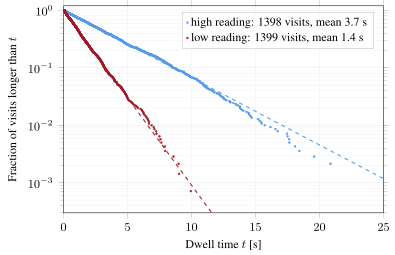
\[\tau_0 = \left(\frac{1}{3.7 \text{ s}} + \frac{1}{1.4 \text{ s}}\right)^{-1} = 1.0 \text{ s}, \quad f_0 = \frac{1}{2\pi\tau_0} = 0.15 \text{ Hz}\]

42

The suspects

Device W/L [µm] \(\Delta V_T\), one electron \(\Delta t/t\)
Comparator input pair 4 x 3.2/0.94 1.6 µV 3 ppm
Comparator load 3.2/0.94 6.4 µV 11 ppm
Reset switch, off leakage 1.92/0.22 46 µV < 1 ppm
PTAT core 3.2/0.94 6.4 µV 30 to 90 ppm
Ramp current mirror unit 3.2/0.94 6.4 µV 190 ppm
Measured 1760 ppm

\(C_{ox}\) = 8.2 fF/µm² (pfet), 8.3 fF/µm² (nfet), from \(t_{oxe}\) in the sky130 model cards; \(nV_T\) = 34 mV

43

How to tell

Source Step \(\Delta t/t\) vs \(T\) Step \(\Delta t/t\) vs \(V_{DD}\)
Comparator offset constant \(\propto 1/V_{DD}\)
Supply ruled out ruled out
Weak inversion current \(\propto 1/T\) or faster constant
Measured falls, 2500 to 1750 ppm from 5 °C to 45 °C not measured
44

Many traps

45

McWhorter: uniform in depth is \(1/f\)

\[\tau = \tau_0 e^{x/\lambda} \Rightarrow dx = \lambda\frac{d\tau}{\tau}\]

\[S(f) \propto \int_{\tau_1}^{\tau_2} \frac{\tau}{1 + \omega^2\tau^2}\frac{d\tau}{\tau} = \frac{1}{\omega}\left[\arctan(\omega\tau)\right]_{\tau_1}^{\tau_2} \approx \frac{\pi}{2\omega}\]

for \(1/\tau_2 \ll \omega \ll 1/\tau_1\)

46
47

Back to the design equation

\[S_{V_G}(f) = \frac{q^2\, kT\, \lambda\, N_t}{W L\, C_{ox}^2\, f}\]

  • \(\lambda\): Schrödinger, the tunnelling length
  • \(kT\): Fermi-Dirac, \(\int f(1-f)\,dE = kT\)
  • \(N_t\): the process, how broken the oxide is
  • \(1/WL\): more traps, each smaller - \(WL \times (1/WL)^2\)
48

The model card knows

BSIM4, flicker noise model 1, as used by ngspice:

\[S_{I_D} \propto \frac{q^2\, kT\, \mu\, I_D}{10^{10}\, f^{EF} A_{bulk} C_{oxe} L^2} \left[\text{NOIA} \ln(\ldots) + \ldots\right]\]

sky130 01v8 \(t_{oxe}\) NOIA [J\(^{-1}\)m\(^{-3}\)] \(N_t\) [cm\(^{-3}\)eV\(^{-1}\)] EF
nfet 4.148 nm 2.5e42 \(4.0 \times 10^{17}\) 0.84
pfet 4.23 nm 1.5e42 \(2.4 \times 10^{17}\) 1.0
49

Summary

  • Noise is random: describe the amplitude by its distribution (usually Gaussian) and the power by its spectral density
  • Integrate the density over the band you keep to get the power the signal must beat; uncorrelated sources add in power
  • Friis: with gain up front, only the first stage's noise matters - spend your current there
  • Thermal noise is Planck, \(4kTR\) below 6 THz; in weak inversion it is shot noise, \(2qI\)
  • Flicker noise comes from traps: a bound state in the oxide, reached by tunnelling, a decade of time constant per 0.18 nm of depth
  • Capture also moves the lattice, which makes it Arrhenius - 226 meV on GR06
  • One trap is a telegraph signal: two Gaussians, exponential dwell times, a Lorentzian - all three measured on GR06
  • Many traps, even in depth, are \(1/f\); small transistors have few, so their noise varies from device to device
  • The simulator's flicker model is the same physics: sky130's NOIA is a trap density, 4e17 per cm³ per eV
50

Would you like to know more?

51