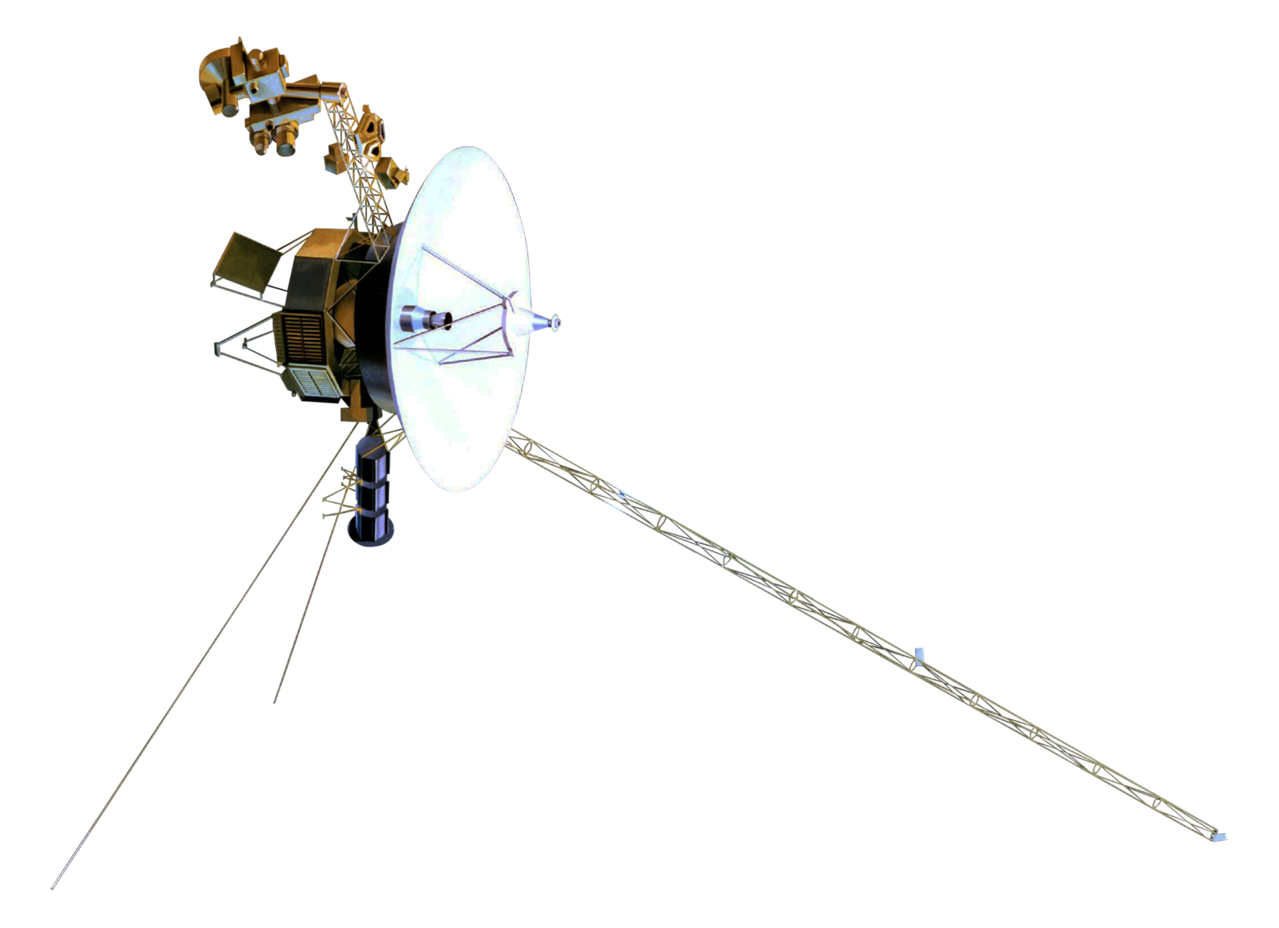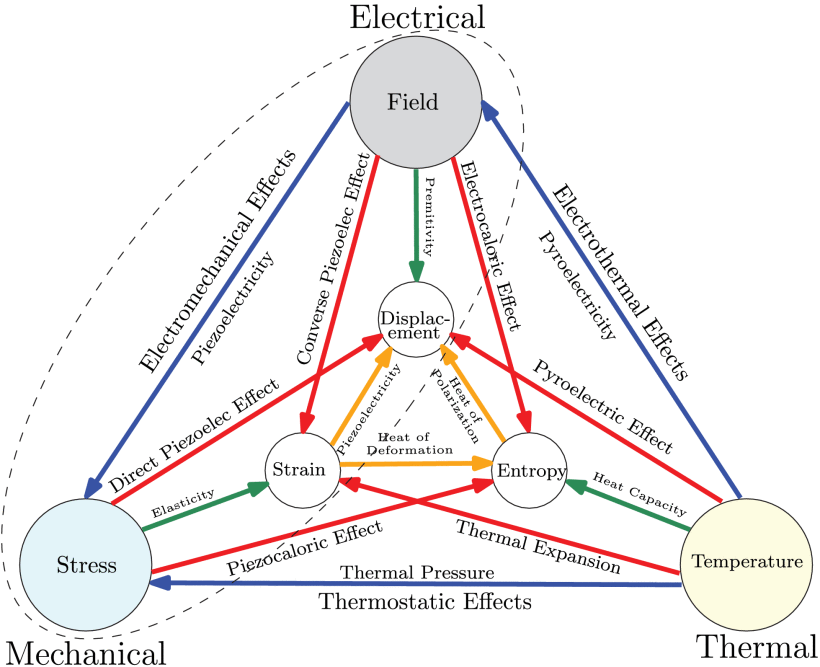
Why do we need energy sources?
Introduction to Energy Harvesting
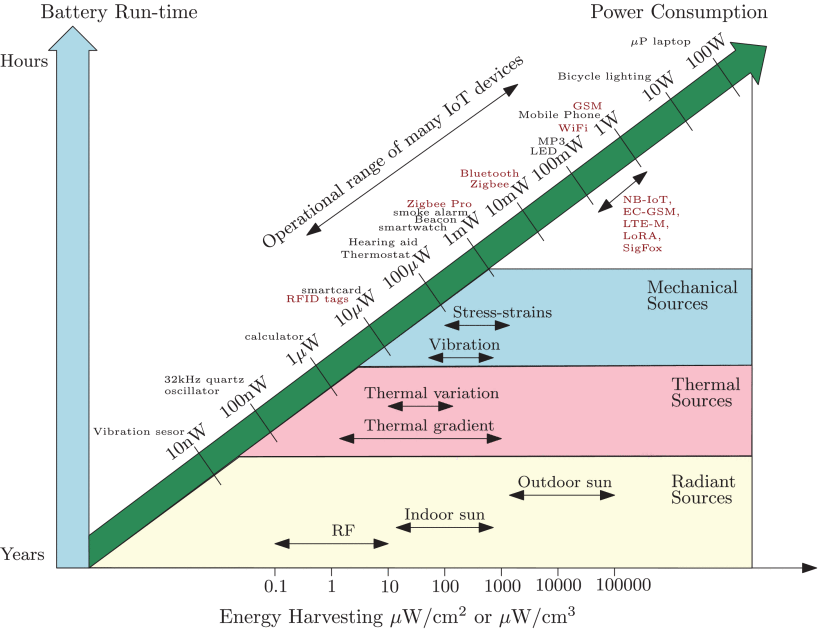
Energy density \(\Rightarrow [250,693]\text{ }mWh/cm^3\)
1 year \(\Rightarrow\) \([29,80]\text{ }\mu\)W/cm\(^3\)
10 year \(\Rightarrow\) \([2.9,8]\text{ }\mu\)W/cm\(^3\)


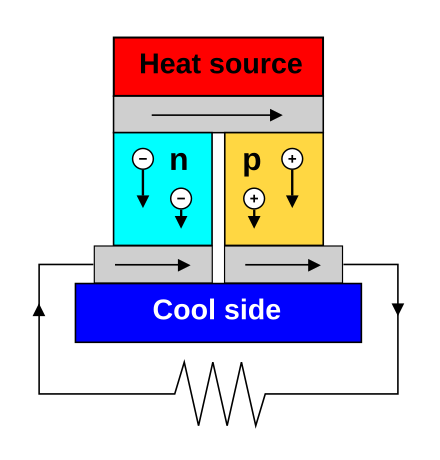
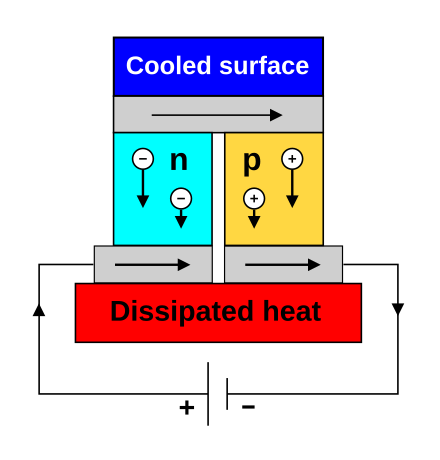
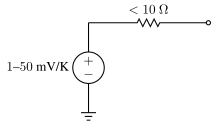
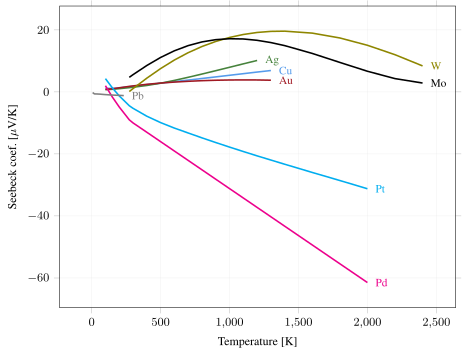
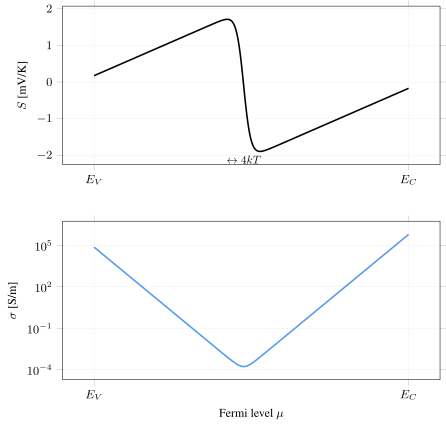
In A 3.5-mV Input Single-Inductor Self-Starting Boost Converter With Loss-Aware MPPT for Efficient Autonomous Body-Heat Energy Harvesting [@bose21] they use a combination of both switched capacitor and switched inductor boost.
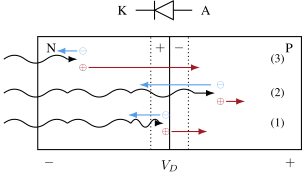
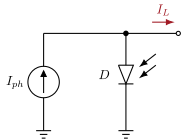
\[I_D = I_S\left(e^\frac{V_D}{V_T} - 1\right)\]
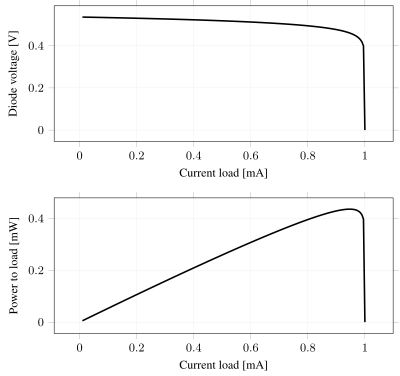
\[I_D = I_{Photo} - I_{Load}\]
\[V_D = V_T ln{\left(\frac{I_{Photo} - I_{Load}}{I_S} + 1 \right)}\]
\[P_{Load} = V_D I_{Load}\]
#!/usr/bin/env python3
import numpy as np
import matplotlib.pyplot as plt
m = 1e-3
i_load = np.linspace(1e-5,1e-3,200)
i_s = 1e-12 # saturation current
i_ph = 1e-3 # Photocurrent
V_T = 1.38e-23*300/1.6e-19 #Thermal voltage
V_D = V_T*np.log((i_ph - i_load)/(i_s) + 1)
P_load = V_D*i_load
plt.subplot(2,1,1)
plt.plot(i_load/m,V_D)
plt.ylabel("Diode voltage [mA]")
plt.grid()
plt.subplot(2,1,2)
plt.plot(i_load/m,P_load/m)
plt.xlabel("Current load [mA]")
plt.ylabel("Power Load [mW]")
plt.grid()
plt.savefig("pv.pdf")
plt.show()
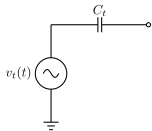
In A Reconfigurable Capacitive Power Converter With Capacitance Redistribution for Indoor Light-Powered Batteryless Internet-of-Things Devices [@cheng21] they include a maximum power point tracker and a reconfigurable charge pump to optimize efficiency.

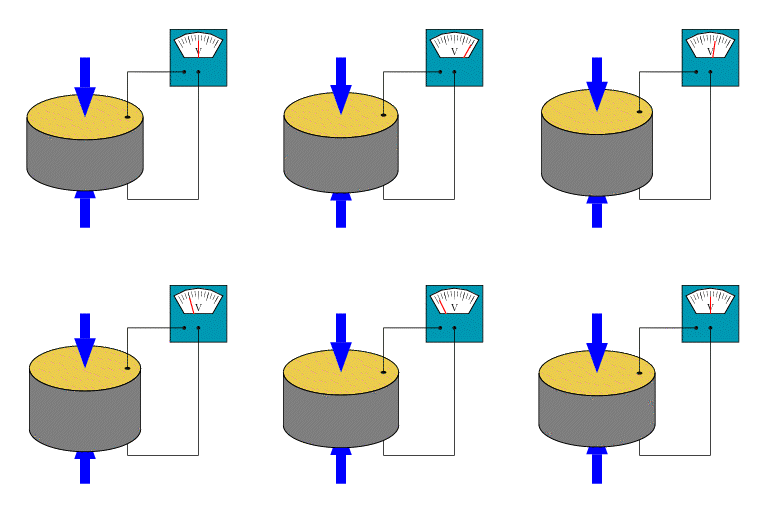
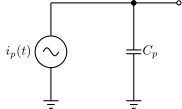
An example of piezoelectric energy harvester can be found in A Fully Integrated Split-Electrode SSHC Rectifier for Piezoelectric Energy Harvesting [@du19]

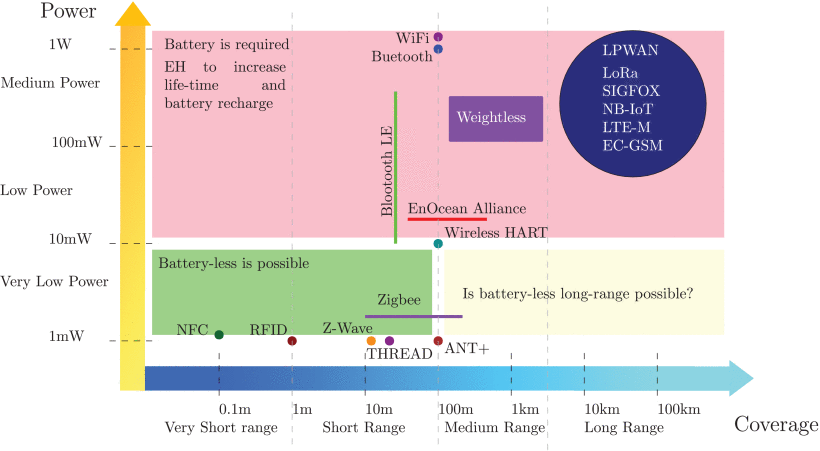
Near Field Communication (NFC) operates at close physical distances
Reactive near field or inductive near field
\[\text{Inductive} < \frac{\lambda}{2 \pi}\]
| Standard | Frequency [MHz] | Inductive [m] |
|---|---|---|
| AirFuel Resonant | 6.78 | 7.03 |
| NFC | 13.56 | 3.52 |
| Qi | 0.205 | 232 |
| Bluetooth | 2400 | 0.02 |
Extremely inefficient idea, but may find special use-cases at short-distance.
Will get better with beam-forming and directive antennas
| dBm | W |
|---|---|
| 30 | 1 |
| 0 | 1 m |
| -30 | 1 u |
| -60 | 1 n |
| -90 | 1 p |
Assume \(P_{TX}\) = 1 W (30 dBm) and \(P_{RX}\) = 10 uW (-20 dBm)
\[D = 10^\frac{P_{TX} - P_{RX} + 20 log_{10}\left(\frac{c}{4 \pi f}\right)}{20}\]
| Freq | \(20 log_{10}\left(c/4 \pi f\right)\) [dB] | D [m] |
|---|---|---|
| 915M | -31.7 | 8.2 |
| 2.45G | -40.2 | 3.1 |
| 5.80G | -47.7 | 1.3 |
Take a look in A Fully Energy-Autonomous Temperature-to-Time Converter Powered by a Triboelectric Energy Harvester for Biomedical Applications [@tan21] for more details.
| Energy source | Power density | Frequency | Characteristics |
|---|---|---|---|
| Solar / PV | 10 uW/cm\(^2\) indoor, 15 mW/cm\(^2\) outdoor | DC | Requires exposure to light |
| RF | 0.1 uW/cm\(^2\) GSM, 0.01 uW/cm\(^2\) WiFi | 380 MHz--5 GHz | Poor indoors and out of line of sight |
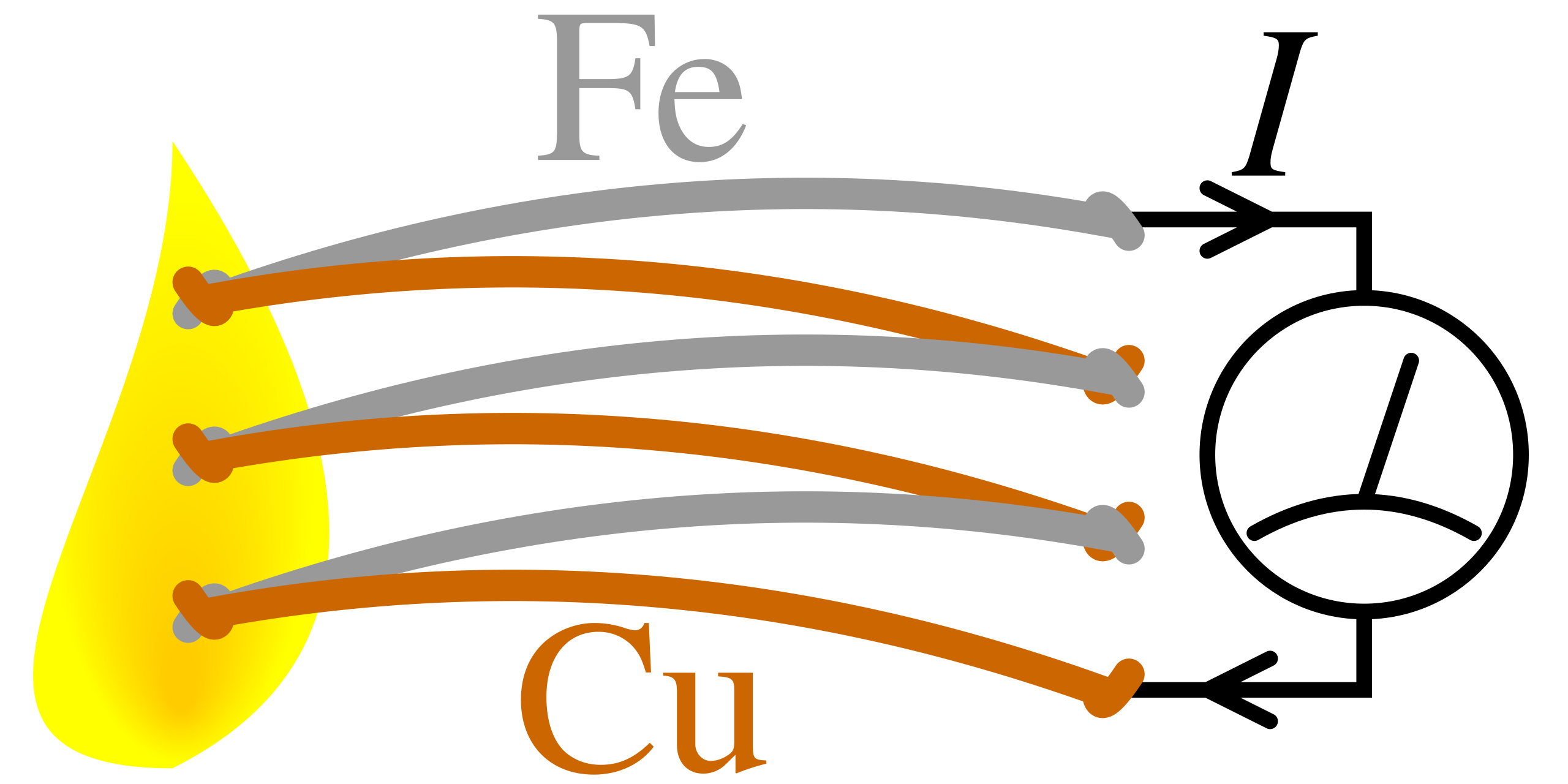
| Thermal, body heat | 40 uW/cm\(^2\) | DC | Requires a high temperature difference |
| Piezoelectric | 4 uW/cm\(^2\) | > 30 Hz | Not limited to indoors or outdoors |
| Triboelectric (TENG) | 1 uW/cm\(^2\) | 1 Hz | Not limited to indoors or outdoors |
[1] Towards a Green and Self-Powered Internet of Things Using Piezoelectric Energy Harvesting [@shirvanimoghaddam19]
A 3.5-mV Input Single-Inductor Self-Starting Boost Converter With Loss-Aware MPPT for Efficient Autonomous Body-Heat Energy Harvesting [@bose21]
A Reconfigurable Capacitive Power Converter With Capacitance Redistribution for Indoor Light-Powered Batteryless Internet- of-Things Devices [@cheng21]
A Fully Integrated Split-Electrode SSHC Rectifier for Piezoelectric Energy Harvesting [@du19]
Current progress on power management systems for triboelectric nanogenerators [@hu22]
A Fully Energy-Autonomous Temperature-to-Time Converter Powered by a Triboelectric Energy Harvester for Biomedical Applications [@tan21]