Carsten Wulff 2026
4
Explain why we need Analog SystemVerilog models
Introduction to Analog SystemVerilog
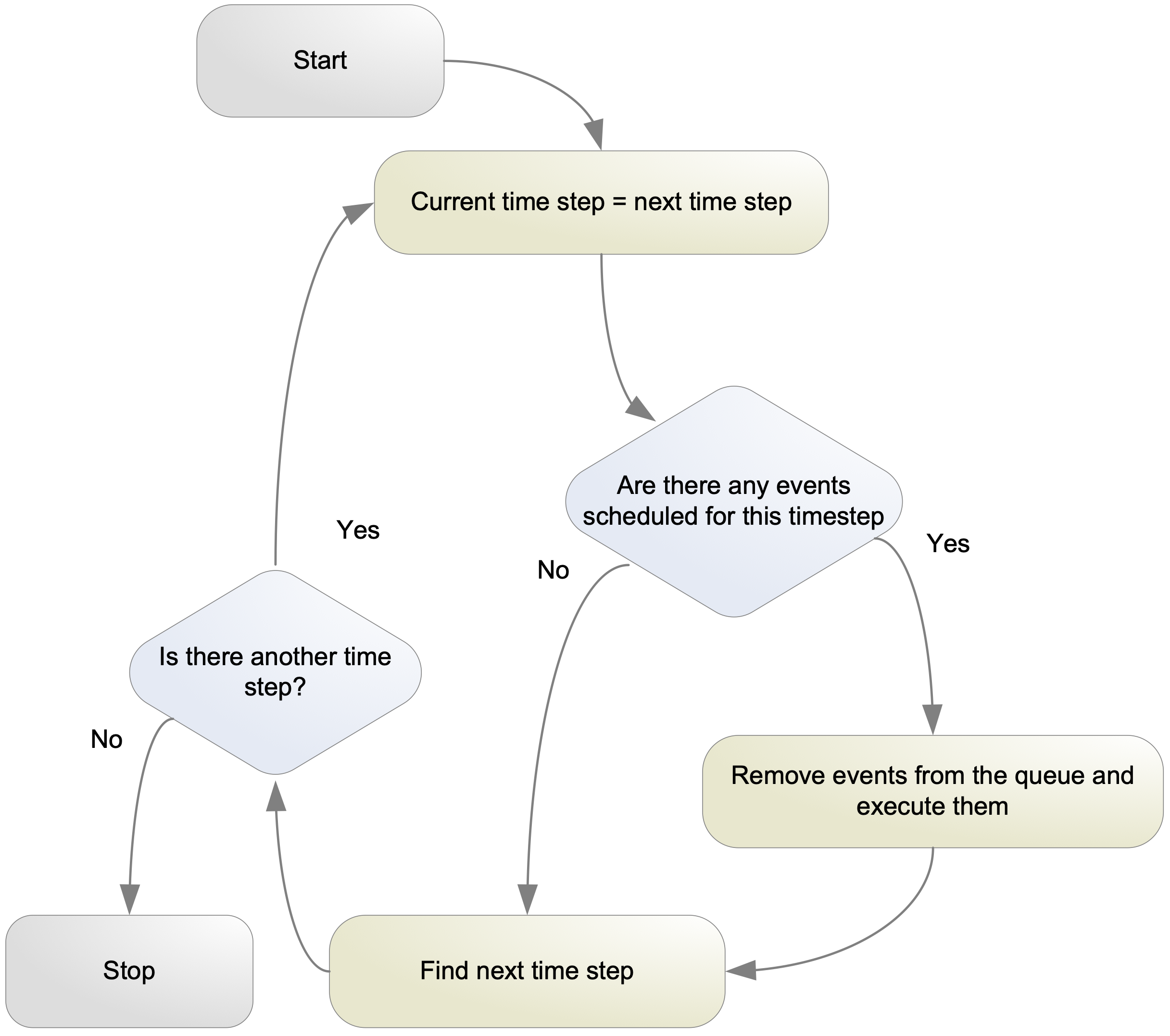
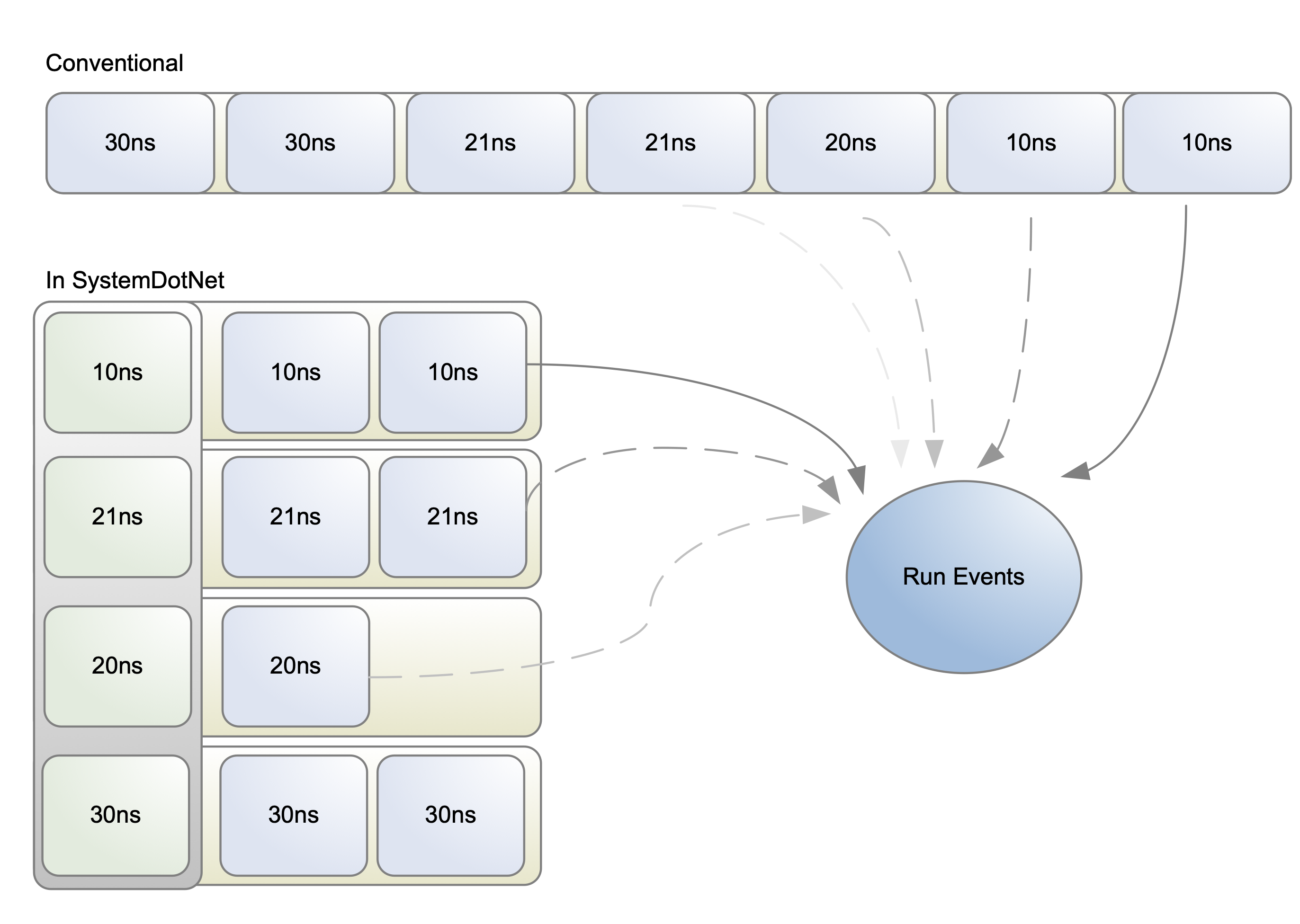
The order of execution of events at the same time-step does not matter
The system is causal. Changes in the future do not affect signals in the past or the now
module counter(
               output logic [WIDTH-1:0] out,
               input logic              clk,
               input logic              reset
               );

   parameter WIDTH = 8;

   logic [WIDTH-1:0]                    count;
   always_comb begin
      count = out + 1;
   end

   always_ff @(posedge clk or posedge reset) begin
      if (reset)
        out <= 0;
      else
        out <= count;
   end

endmodule // counter
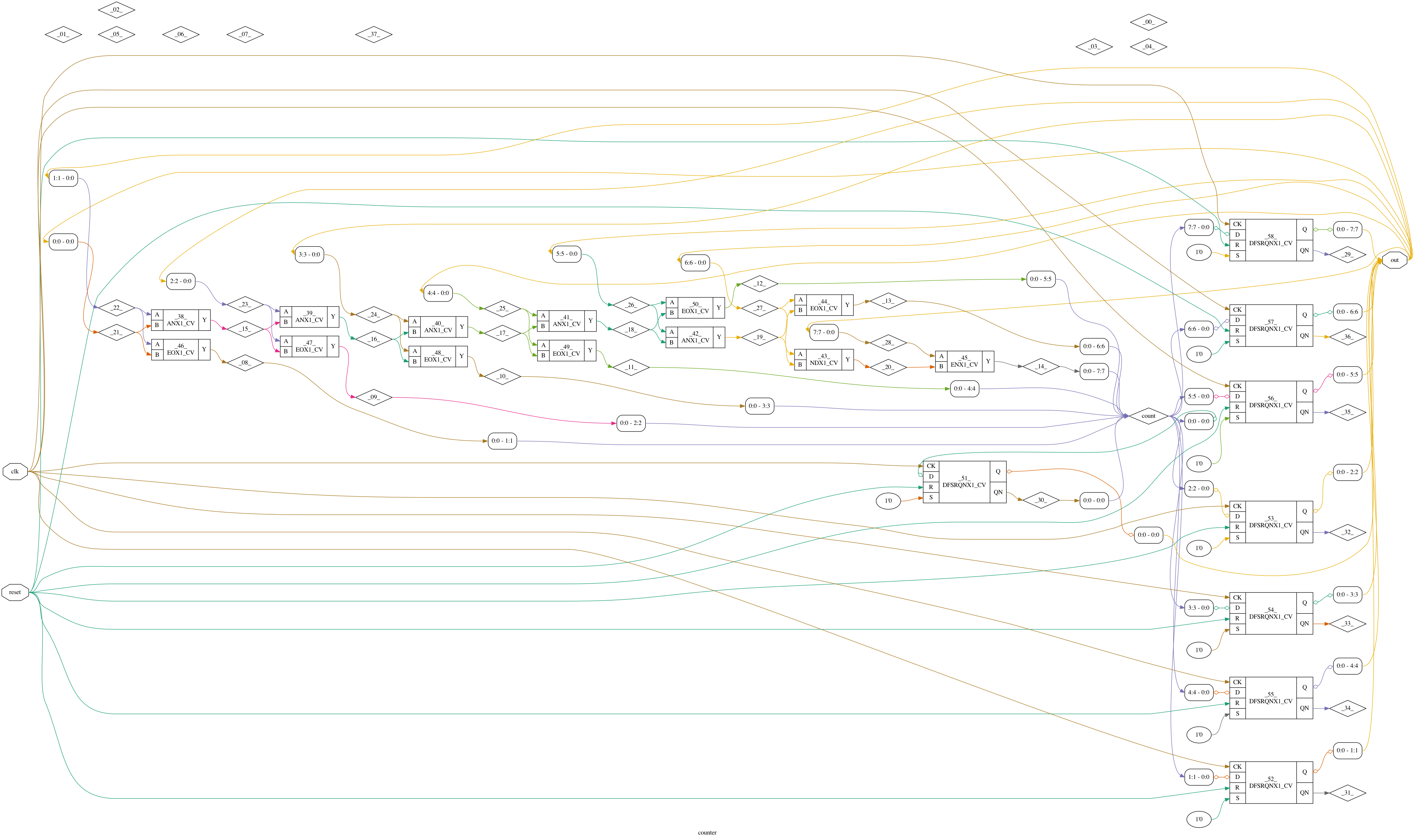
Assume `clk, reset, out = 0`

Assume event with `clk = 1`

0: Set `out = count` in next event (1)

1: Set `count = out + 1` using
   logic (may consume multiple events)

X: no further events
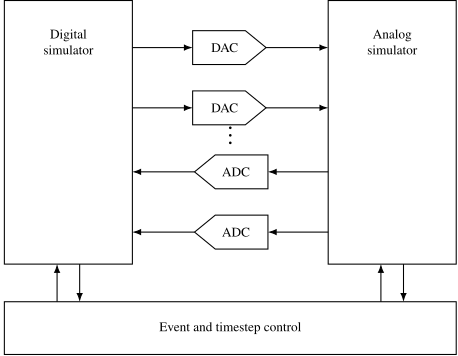
parse spice netlist, and setup partial/ordinary differential equations for node matrix
\[\begin{pmatrix} G_{11} &G_{12} &\cdots &G_{1N} \\ G_{21} &G_{22} &\cdots &G_{2N} \\ \vdots &\vdots &\ddots & \vdots\\ G_{N1} &G_{N2} &\cdots &G_{NN} \end{pmatrix} \begin{pmatrix} v_1\\ v_2\\ \vdots\\ v_N \end{pmatrix}= \begin{pmatrix} i_1\\ i_2\\ \vdots\\ i_N \end{pmatrix}\]
model the non-linear current/voltage behavior between all nodes
numerical methods to compute time evolution
SPICE (Simulation Program with Integrated Circuit Emphasis) published in 1973 by Nagel and Pederson
Commercial - Cadence Spectre - Siemens Eldo - Synopsys HSPICE
Free - Aimspice - Analog Devices LTspice - xyce
Open Source - ngspice
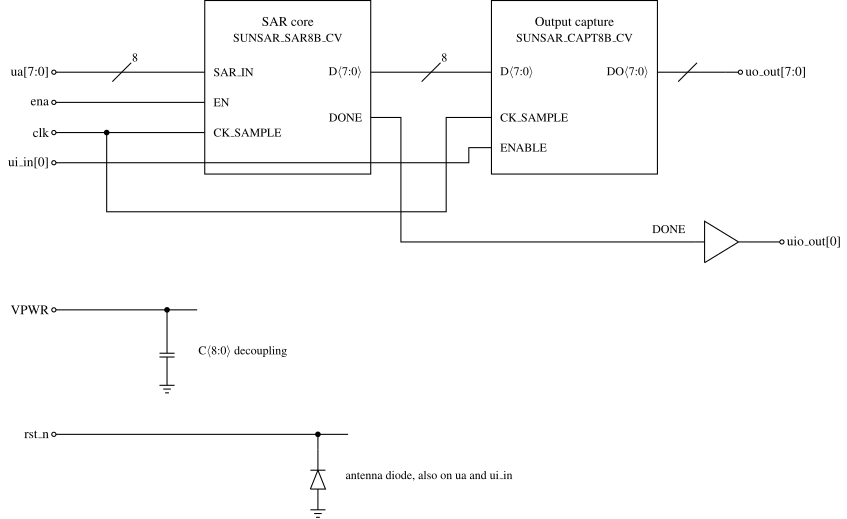
//tt06-sar/src/project.v
module tt_um_TT06_SAR_wulffern (
                                input wire        VGND,
                                input wire        VPWR,
                                input wire [7:0]  ui_in,
                                output wire [7:0] uo_out,
                                input wire [7:0]  uio_in,
                                output wire [7:0] uio_out,
                                output wire [7:0] uio_oe,
`ifdef ANA_TYPE_REAL
                                input real        ua_0,
                                input real        ua_1,
`else
                                // analog pins
                                inout wire [7:0]  ua,
`endif
                                input wire        ena,
                                input wire        clk,
                                input wire        rst_n
                                );
//tt06-sar/src/tb_ana.v
`ifdef ANA_TYPE_REAL
   real        ua_0  = 0;
   real        ua_1 = 0;

`else
   tri [7:0]   ua;
   logic       uain = 0;
   assign ua = uain;
`endif

`ifdef ANA_TYPE_REAL
   always #100 begin
      ua_0 = \(sin(2*3.14*1/7750*\)time);
      ua_1 = -\(sin(2*3.14*1/7750*\)time);
   end
`endif
//tt06-sar/src/tb_ana.v
   tt_um_TT06_SAR_wulffern dut (
                                .VGND(VGND),
                                .VPWR(VPWR),
                                .ui_in(ui_in),
                                .uo_out(uo_out),
                                .uio_in(uio_in),
                                .uio_out(uio_out),
                                .uio_oe(uio_oe),
`ifdef ANA_TYPE_REAL
                                .ua_0(ua_0),
                                .ua_1(ua_1),
`else
                                .ua(ua),
`endif
                                .ena(ena),
                                .clk(clk),
                                .rst_n(rst_n)
                                );
#tt06-sar/src/Makefile
runa:
    iverilog  -g2012 -o my_design -c tb_ana.fl -DANA_TYPE_REAL
    vvp -n my_design

rund:
    iverilog  -g2012 -o my_design -c tb_ana.fl
    vvp -n my_design
   //tt06-sar/src/project.v
   //Main SAR loop
   always_ff @(posedge clk or negedge clk) begin
      if(~ui_in[0]) begin
         state <= OFF;
         tmp = 0;
         dout = 0;
      end
      else begin
         if(OFF) begin

         end
         else if(clk == 1) begin
            state = SAMPLE;
         end
         else if(clk == 0) begin
            state = CONVERT;
      `ifdef ANA_TYPE_REAL
            smpl = ua_0 - ua_1;
            tmp = smpl;

            for(int i=7;i>=0;i--) begin
               if(tmp >= 0) begin
                  tmp = tmp - lsb*2**(i-1);
                  if(i==7)
                    dout[i] <= 0;
                  else
                    dout[i] <= 1;
               end
               else begin
                  tmp = tmp + lsb*2**(i-1);
                  if(i==7)
                    dout[i] = 1;
                  else
                    dout[i] = 0;
               end
            end
`else
            if(tmp == 0) begin
               dout[7] <= 1;
               tmp <= 1;

            end
            else begin
               dout[7] <= 0;
               tmp  = 0;
            end
`endif

         end
         state = next_state;
      end // else: !if(~ui_in[0])
   end // always_ff @ (posedge clk)
   //tt06-sar/src/project.v
   always @(posedge done) begin
      state = DONE;
      sampled_dout = dout;
   end

   always @(state) begin
      if(state == OFF)
        #2 done = 0;
      else if(state == SAMPLE)
        #1.6 done = 0;
      else if(state == CONVERT)
        #115 done = 1;
   end