Why
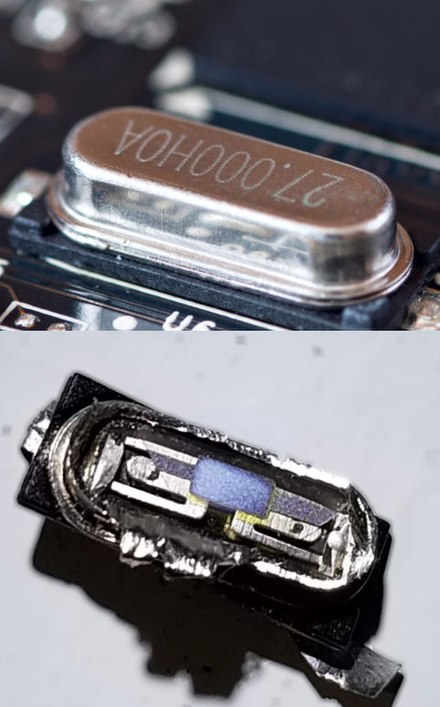
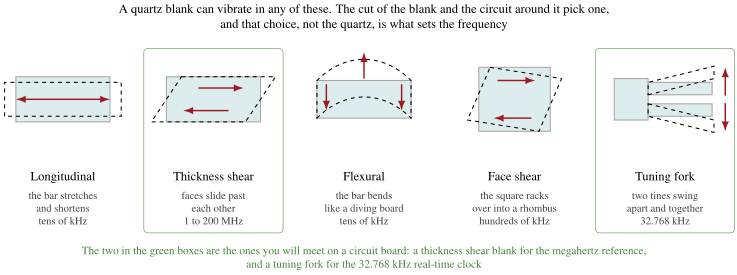
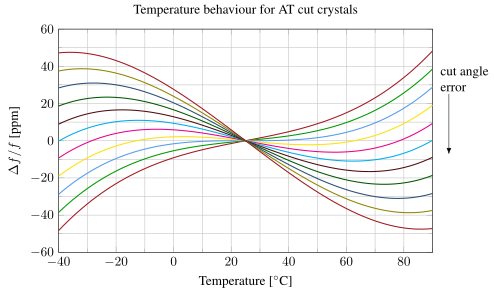
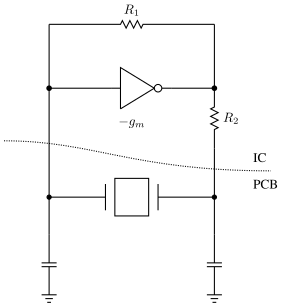
Introduction to Crystal Oscillators
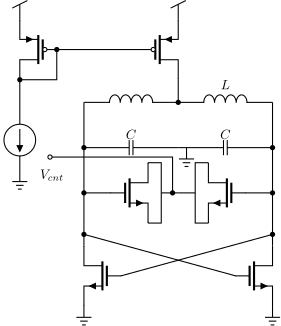
Introduction to VCOs
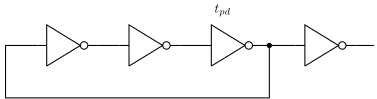
Introduction to Relaxation-oscillators
The second is defined by taking the fixed numerical value of the cesium frequency Cs, the unperturbed ground-state hyper-fine transition frequency of the cesium 133 atom, to be 9 192 631 770 when expressed in the unit Hz, which is equal to s–1
"Ask for a quote" => The price is really high, and we don't want to tell you yet
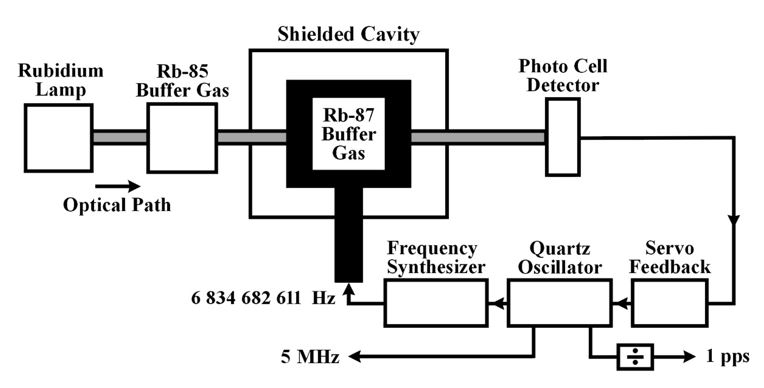
Rubidium standard, use the rubidium hyper-fine transition of 6.8 GHz (6834682610.904 Hz)
The MAC is a passive atomic clock, incorporating the interrogation technique of Coherent Population Trapping (CPT) and operating upon the D1 optical resonance of atomic Rubidium Isotope 87.
A rubidium clock is basically a crystal oscillator locked to an atomic reference.


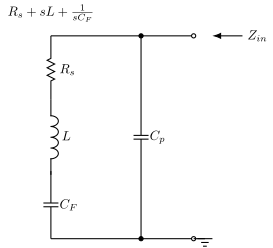
Assuming zero series resistance
\[Z_{in} = \frac{s^2 C_F L + 1}{s^3 C_P L C_F + s C_P + s C_F}\]
Divide top and bottom by \(s\) and the shape is easier to see:
\[Z_{in} = \frac{1}{s}\cdot\frac{L C_F s^2 + 1}{L C_F C_P s^2 + C_F + C_P}\]
See Crystal oscillator impedance for a detailed explanation, or the interactive version where the motional and static elements are sliders and the pulling is worked out for you.
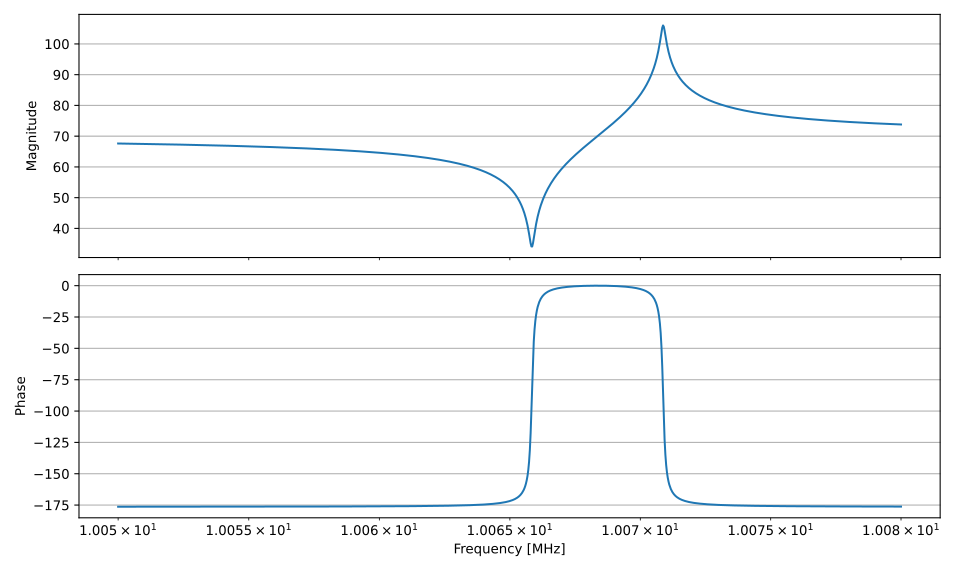
Negative transconductance compensate crystal series resistance
Long startup time caused by high Q
Can fine tune frequency with parasitic capacitance
\[t_{pd} \approx R C\]
\[R \approx \frac{1}{gm} \approx \frac{1}{\mu_n C_{ox} \frac{W}{L} (VDD - V_{th})}\]
\[C \approx \frac{2}{3} C_{ox} W L\]
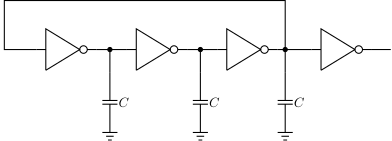
\[t_{pd} \approx \frac{2/3 C_{ox} W L}{\frac{W}{L} \mu_n C_{ox}(VDD - V_{th})}\]
\(f = \frac{1}{2 N t_{pd}} = \frac{\mu_n (VDD-V_{th})}{\frac{4}{3} N L^2}\)
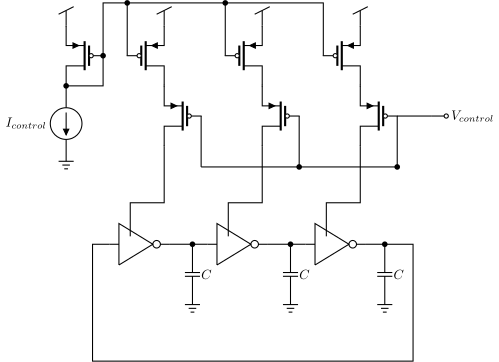
\[K_{vco} = 2 \pi \frac{\partial f}{\partial VDD} = \frac{2 \pi \mu_n}{\frac{4}{3} N L^2}\]
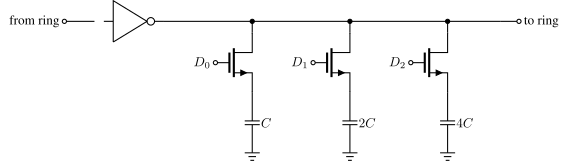
\[f = \frac{\mu_n C_{ox} \frac{W}{L} (VDD - V_{th})}{2N\left(\frac{2}{3}C_{ox}WL + C\right)}\]
\[K_{vco} = \frac{2 \pi \mu_n C_{ox} \frac{W}{L}}{2N\left(\frac{2}{3}C_{ox}WL + C\right)}\]
\[I = C \frac{dV}{dt}\]
\[f \approx \frac{ I_{control} + \frac{1}{2}\mu_p C_{ox} \frac{W}{L} (VDD - V_{control} - V_{th})^2}{C \frac{VDD}{2} N}\]
\[K_{vco} = 2 \pi \frac{\partial f}{\partial V_{control}}\]
\[K_{vco} = - 2 \pi \frac{\mu_p C_{ox} \frac{W}{L} \left(VDD - V_{control} - V_{th}\right) }{C\frac{VDD}{2}N}\]
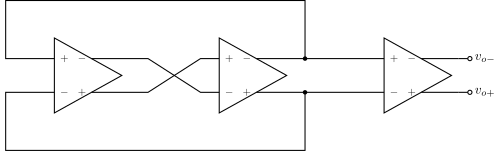
\[f \propto \frac{1}{\sqrt{LC}}\]
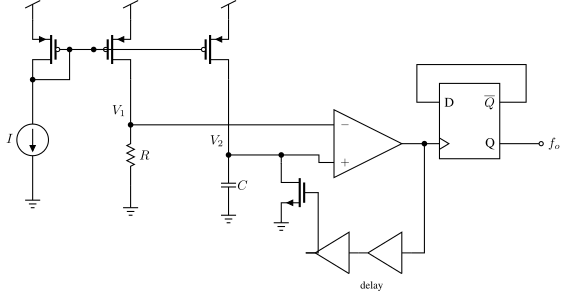
\[V_1 = I R\]
\[I = C \frac{dV}{dt}\]
\[dt = \frac{C V_2}{I} = \frac{C I R}{I}\]
\[f = \frac{1}{dt} = \frac{1}{RC}\]
\[f_o = \frac{1}{2}f = \frac{1}{2RC}\]
The Crystal Oscillator - A Circuit for All Seasons [@razavi17]
High-performance crystal oscillator circuits: theory and application [@vittoz88]
Ultra-low Power 32kHz Crystal Oscillators: Fundamentals and Design Techniques [@xu21]
A Sub-nW Single-Supply 32-kHz Sub-Harmonic Pulse Injection Crystal Oscillator [@kim21]
The Ring Oscillator - A Circuit for All Seasons [@razavi19]
A Study of Phase Noise in CMOS Oscillators [@razavi96]
An Ultra-Low-Noise Swing-Boosted Differential Relaxation Oscillator in 0.18-um CMOS [@lee20]