TFE4188 - Lecture 4

Analog frontend and filters

1

Why

2

The behavior of particles is written in the mathematics of quantum mechanics

\(\psi(x,t) = Ae^{j(kx - \omega t)}\) Probability amplitude of a particle

\(\frac{1}{2 m} \frac{\hbar}{j^2} \frac{\partial^2}{\partial^2 x}\psi(x,t) + U(x)\psi(x,t) = -\frac{\hbar}{j}\frac{\partial}{\partial t} \psi(x,t)\) Time evolution of the energy of a particle[^2]

\(\frac{n_n}{n_p} = \frac{e^{(E_{p} - \mu) / kT} + 1}{e^{(E_{n} - \mu) / kT} + 1}\) Relates the average number of fermions in thermal equlilibrium to the energy of a single-particle state[^3]

[^2]: Schrödinger equation

[^3]: Fermi-Dirac statistics

3
The world is analog and is written in the mathematics of calculus [^1]

\(\oint_{\partial \Omega} \mathbf{E} \cdot d\mathbf{S} = \frac{1}{\epsilon_0} \iiint_{V} \rho \cdot dV\)
Relates net electric flux to net enclosed electric charge

\(\oint_{\partial \Omega} \mathbf{B} \cdot d\mathbf{S} = 0\) Relates net magnetic flux to net enclosed magnetic charge

\(\oint_{\partial \Sigma} \mathbf{E} \cdot d\mathbf{\ell} = - \frac{d}{dt}\iint_\Sigma \mathbf{B} \cdot d\mathbf{S}\) Relates induced electric field to changing magnetic flux

\(\oint_{\partial \Sigma} \mathbf{B} \cdot d\mathbf{\ell} = \mu_0\left( \iint_\Sigma \mathbf{J} \cdot d\mathbf{S} + \epsilon_0 \frac{d}{dt}\iint_\Sigma \mathbf{E} \cdot d\mathbf{S} \right)\) Relates induced magnetic field to changing electric flux and to current

[^1]: Maxwell's equations

4

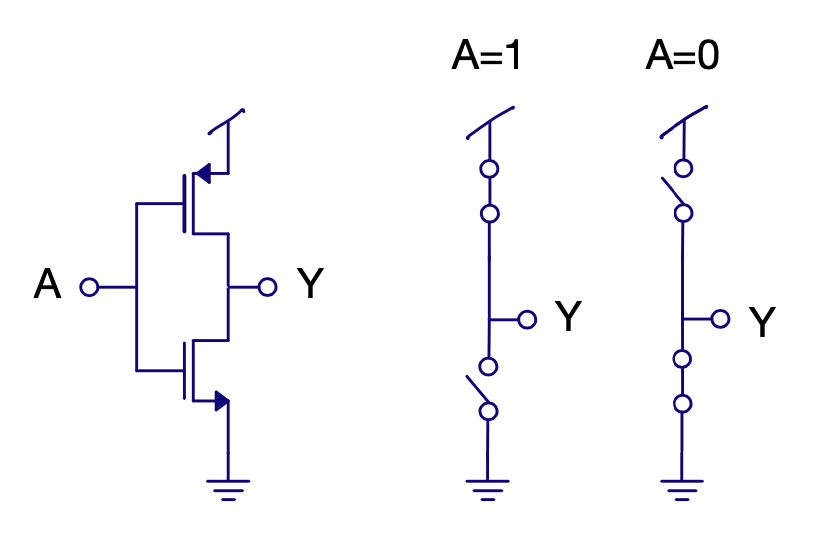
The abstract digital world is written in the mathematics of boolean algebra[^4]

\(1 = \text{True}\), \(0 = \text{False}\)

A B NOT(A AND B)
0 0 1
0 1 1
1 0 1
1 1 0

All digital processing can be made with the NOT(A AND B) function!

[^4]: Boolean algebra

5

People that make digital circuits can easily reuse the work of others

6

People that make analog circuits can learn from others, but need to deal with the real world on their own

7

Should we do as much as possible in the abstract digital world?

8
9
What Power [dBm] Voltage [V]
Blocker -30 7 m
Wanted -90 7 u
Resolution Wanted/255 = 28 n

\(\text{ ADC resolution }\Rightarrow \ln{ \frac{7 \text{ mV}}{28 \text{ nV}} }/\ln{2} \approx 18 \text{ bits}\)

10

\[FOM = \frac{P}{2^{ENOB}fs}\]

\[P = 1\text{ fJ/step} \times 2^{18} \times 5\text{GHz} = 1.31\text{ W}\]

Whoop battery is 205mAh at 3.8 V

\[\text{ Hours} = \frac{ 205 \text{ mAh}}{1.31\text{ W}/3.8\text{ V}} = 0.6\text{ h}\]

Nordic Inside

11
12

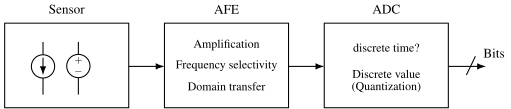
You must know application before you make the AFE!

13

Filters

14

A combination of 1'st and 2'nd order stages can synthesize any order filter

15

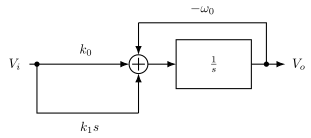
First order filter

  1. any line with a coefficient is a multiplier
  2. any box output is a multiplication of the coefficient and the input
  3. any sum, well, sum all inputs
  4. be aware of gremlins (a sudden -+ swap)

\[H(s) =\frac{V_o(s)}{V_i(s)} = \frac{ k_1 s + k_0 }{s + w_o}\]

16

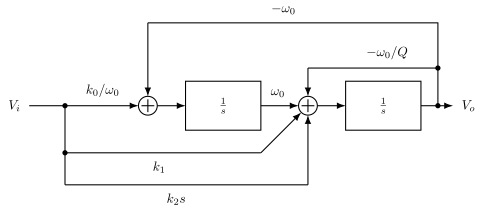
Second order filter

Bi-quadratic is a general purpose second order filter.

\[H(s) = \frac{k_2 s^2 + k_1 s + k_0}{s^2 + \frac{\omega_0}{Q} s + \omega_o^2}\]

17

How do we implement the filter sections?

18

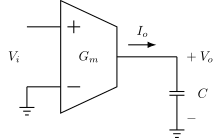
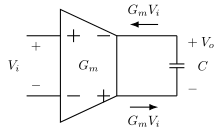
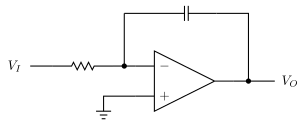
Gm-C

19

\[V_o = \frac{I_o}{s C} = \frac{\omega_{ti}}{s} V_i\]

\[\omega_{ti} = \frac{G_m}{C}\]

20

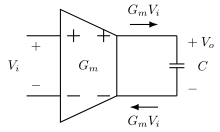
\[s C V_o = G_m Vi\]

\[H(s) = \frac{V_o}{V_i} = \frac{G_m}{sC}\]

21

\[H(s) = \frac{V_o}{V_i} = -\frac{G_m}{sC}\]

22

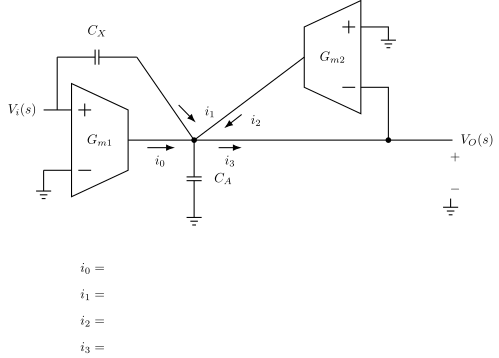
\[H(s) = \frac{ k_1 s + k_0 }{s + w_o}\]

\[H(s) = \frac{s \frac{C_x}{C_a + C_x} + \frac{G_{m1}}{C_a + C_x}}{s + \frac{G_{m2}}{C_a + C_x}}\]

23

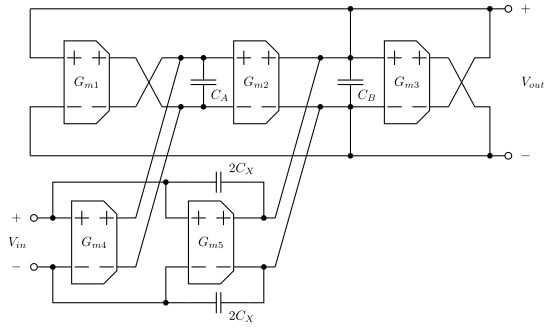
\[H(s) = \frac{k_2 s^2 + k_1 s + k_0}{s^2 + \frac{\omega_0}{Q} s + \omega_o^2}\]

\[H(s) = \frac{ s^2\frac{C_X}{C_X + C_B} + s\frac{G_{m5}}{C_X + C_B} + \frac{G_{m2}G_{m4}}{C_A(C_X + C_B)}} {s^2 + s\frac{G_{m3}}{C_X + C_B} + \frac{G_{m1}G_{m2}}{C_A(C_X + C_B)} }\]

24

25

Active-RC

26

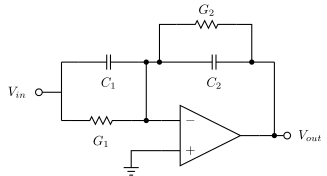
General purpose first order filter

\[H(s) = \frac{ k_1 s + k_0 }{s + w_o}\]

\[H(s) = \frac{ -\frac{C_1}{C_2}s -\frac{G_1}{ C_2}}{s + \frac{G_2}{ C_2}}\]

27

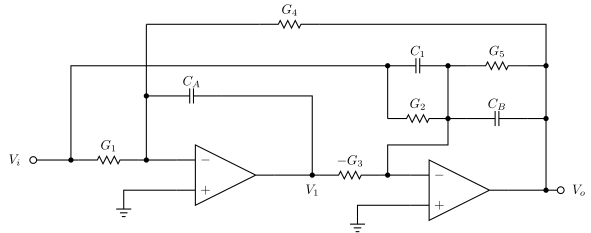
General purpose biquad

\[H(s) = \frac{k_2 s^2 + k_1 s + k_0}{s^2 + \frac{\omega_0}{Q} s + \omega_o^2}\]

\[H(s) = \frac{\left[ \frac{C_1}{C_B}s^2 + \frac{G_2}{C_B}s + (\frac{G_1G_3}{C_A C_B})\right]}{\left[ s^2 + \frac{G_5}{C_B}s + \frac{G_3 G_4}{C_A C_B}\right]}\]

28

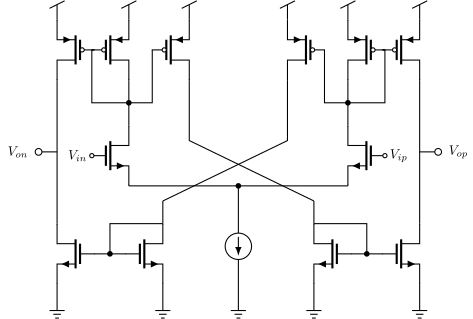
The OTA is not ideal

\[H(s) \approx \frac{A_0}{(1 + s A_o R C)(1 + \frac{s}{w_{ta}})}\]

where \(A_0\) is the gain of the amplifier, and \(\omega_{ta}\) is the unity-gain frequency.

29
30
31

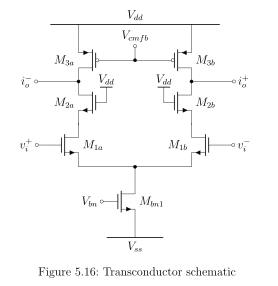
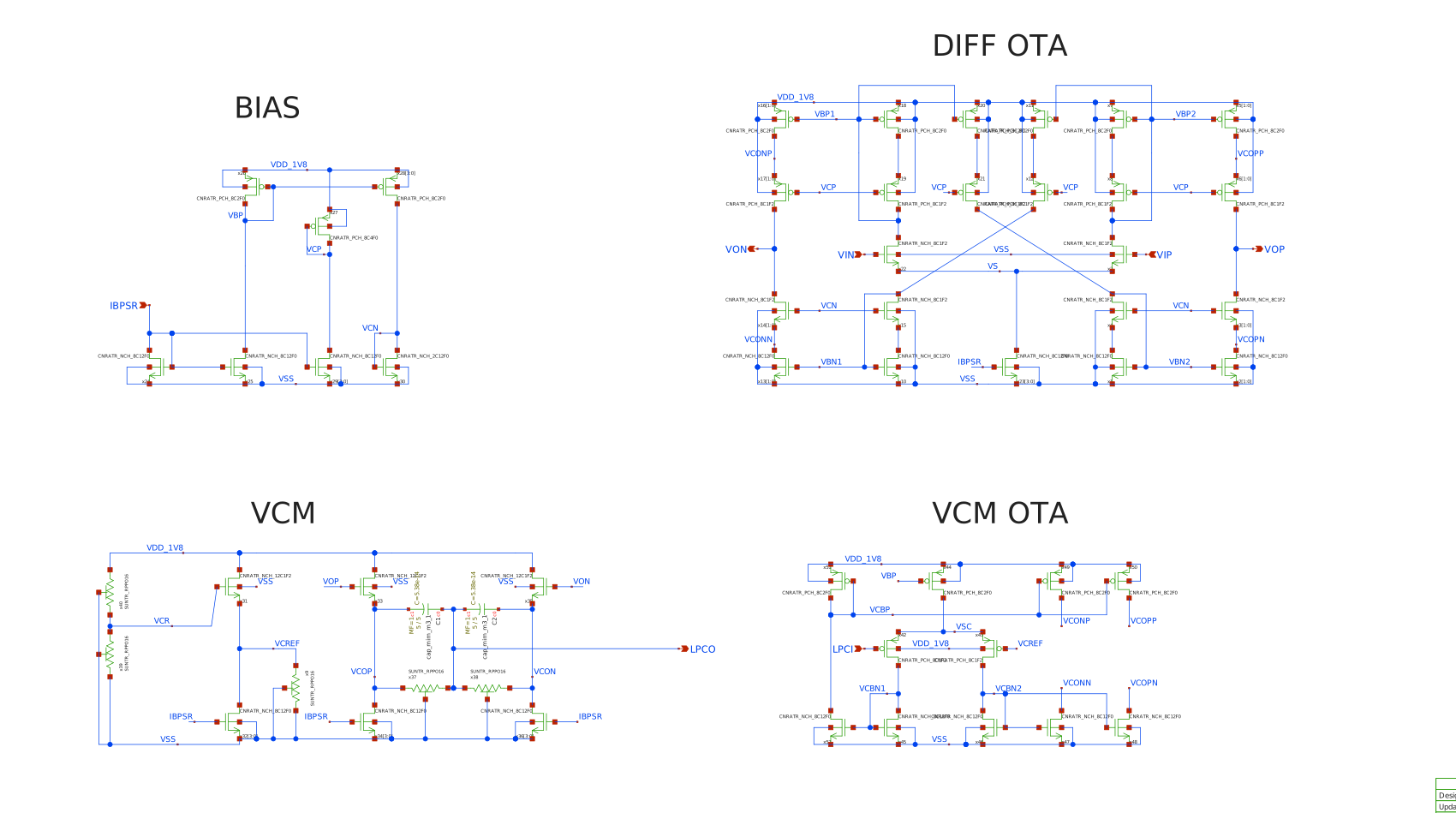
My favorite OTA

32
33
34
35
36

Summary

  • The frontend's job is to hand the ADC a signal it can afford to convert: gain where it is cheap, filtering before sampling folds noise in
  • First order sections come from one gm and one C; biquads stack them with feedback and give Q
  • Gm-C is fast and open loop, active-RC is linear and closed loop - the OTA pays either way
  • A real OTA's finite gain and bandwidth move the filter poles; design the OTA from the filter's error budget
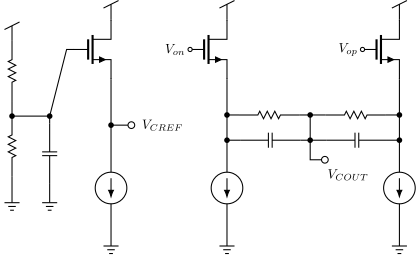
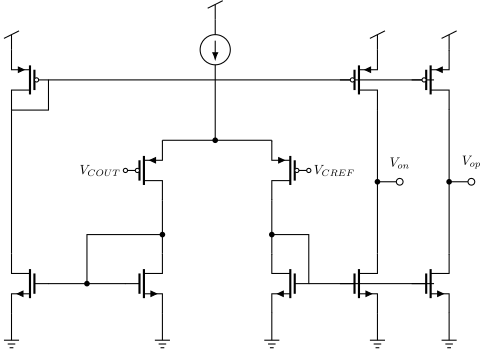
  • Fully differential filters double swing and cancel even harmonics, and carry the CMFB tax
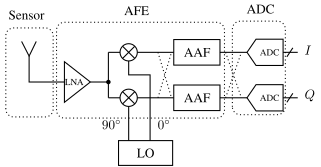
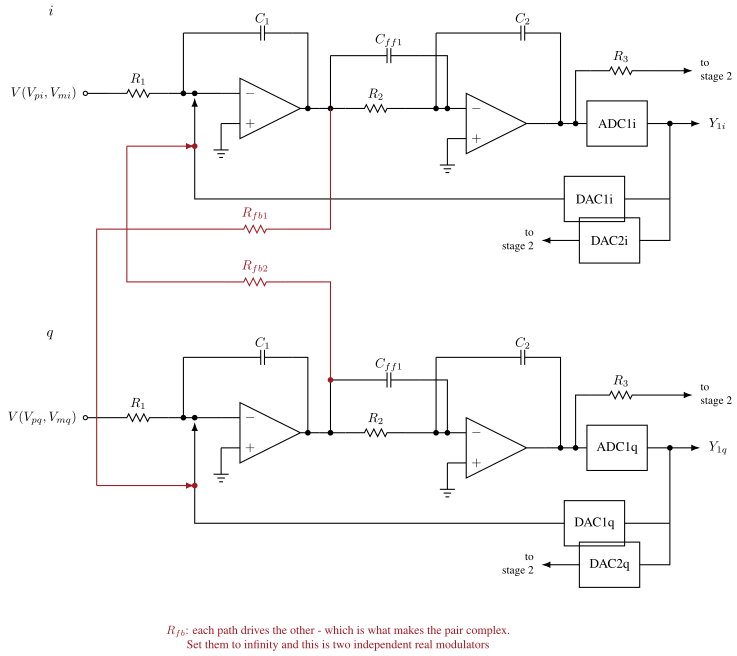
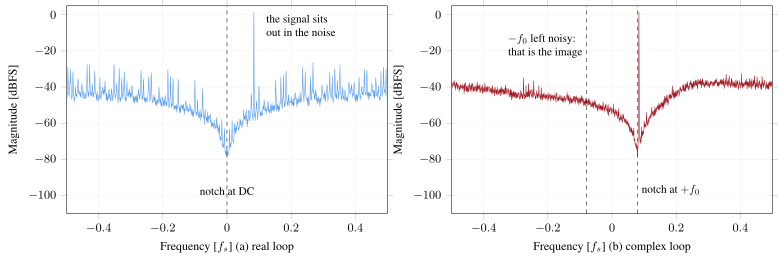
  • A complex (quadrature) filter is two real paths plus cross-coupling: the response stops being symmetric about zero, which a low-IF radio needs
37

Would you like to know more?

38

Thanks!

39